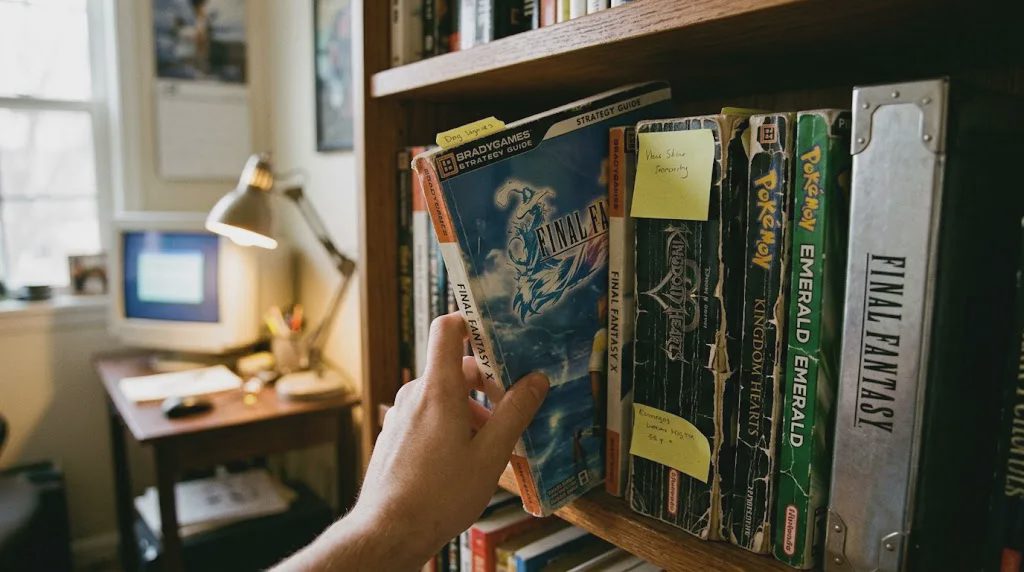
I have a shelf in my apartment that doesn't make much sense.
It's not the bookshelf in the living room—that one is organised, intentional, filled with novels I've actually read and a few I swear I'll get to. No, this is a smaller shelf, tucked away near my desk, and it holds things I have no practical use for. A worn copy of the Pokémon Emerald strategy guide, spine cracked from years of flipping through it. The Final Fantasy X hardcover, corners dog-eared. A battered Kingdom Hearts guide with sticky notes still clinging to the pages.
I haven't opened most of them in years. I don't need them. If I ever need to find a secret item or solve a puzzle, I can look it up on my phone in five seconds. YouTube has full walkthroughs. Wikis have every scrap of data the developers ever coded.
And yet, I can't bring myself to throw them away.
What Strategy Guides Meant Then
I grew up in an era when a strategy guide was more than a tool. It was a luxury.
You'd finish a game and find out there was a whole side quest you missed. Or you'd be stuck on a boss for days, and the only way forward was a trip to the local game shop, where you'd flip through the guide just long enough to get the answer without actually buying it. If you were lucky, a friend would let you borrow theirs for a weekend.
Actually owning one felt special. It meant you cared enough about the game to invest in it beyond the cartridge or disc. It was a way of saying: this one matters to me.
The guides themselves were objects of craft. Thick, glossy pages. Detailed maps. Beautiful screenshots. Walkthroughs written in a voice that felt like a wise older sibling guiding you through something complicated. Some guides, like the ones from Piggyback or BradyGames, were practically art books in their own right.
I remember saving up pocket money for the Ocarina of Time guide. I must have read it cover to cover three times before I even owned the game. The maps became as familiar to me as the streets of my own neighbourhood.
What the Internet Can't Replace
You might argue that digital guides are objectively better. And you'd be right—in most ways.
They're searchable. They're updated when developers patch the game or release DLC. They include community discoveries that no official guide ever could. If you're stuck on a particular boss in Elden Ring, you can watch a two-minute video that shows you exactly how to beat it. No flipping through pages. No guessing.
But here's what the internet doesn't have: the physical memory.
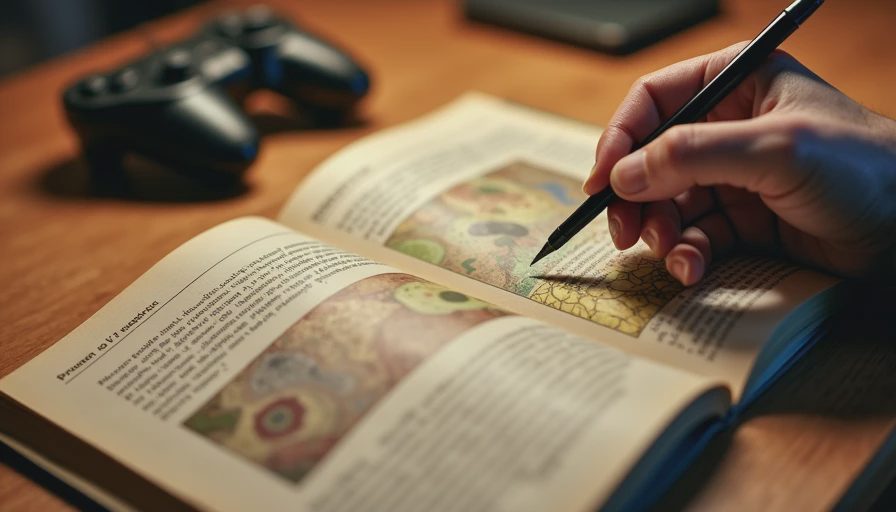
A strategy guide sits in your hands. You feel its weight. You remember the specific page you kept returning to. You see the coffee stain from a late-night session. You find the dog-eared corner that marks the boss you struggled with for three days.
Those things aren't information. They're memories.
When I pull out my Kingdom Hearts guide, I don't look up how to beat a boss. I remember sitting on my bedroom floor at fifteen, reading it by lamplight, trying to understand why the story got so complicated. I remember the excitement of realising there was a whole secret ending I'd never seen. The guide was never just a set of instructions. It was a companion.
The Weight of Paper
There's a deeper reason I keep them, though. And it's not just about memory.
It's about the pace of reading.
Online guides are designed for efficiency. You search for what you need, you find it, you move on. They're tools, pure and simple. And that's fine—most of the time, that's exactly what I want.
But a printed guide asks you to slow down. You can't Ctrl+F your way to the answer. You have to flip through pages, browse, discover things you weren't even looking for. You might read about a side quest you didn't know existed, or see a screenshot that makes you appreciate a game's design in a new way.
There's a pleasure in that—a kind of reading that the internet doesn't offer. It's the same reason people still buy vinyl records or physical books. The friction is part of the experience.
I also appreciate the permanence. A printed guide is complete. It doesn't get edited, taken down, or locked behind a paywall. It represents a moment in time—the developers' vision, as it existed at launch, before patches and DLC and community re-evaluations changed the conversation. There's something honest about that.

What They Represent Now
When I look at that shelf today, I don't see reference materials. I see a timeline of my younger self.
The Pokémon Yellow guide, held together with tape—that's eight-year-old me, learning to read by matching words to screenshots. The Final Fantasy VII guide, heavily annotated—that's teenage me, trying to understand narrative complexity for the first time. The Okami guide, barely used—that's older me, realising I didn't have the patience for collect-a-thons.
Each guide is a bookmark in my life. Not for the games themselves, necessarily, but for who I was when I played them.
One player I know described keeping guides as "keeping photos of old friends". I think that's right. The guides themselves are impersonal objects, but what they carry—the memories, the curiosity, the late nights—is anything but.
The Honest Verdict
So will I ever use these guides again? Probably not. If I replay Final Fantasy X next month, I'll look up the celestial weapon requirements on my phone like everyone else. The guide will stay on the shelf.
But I'm not keeping them for utility. I'm keeping them because they're part of my history. They're physical proof that I cared about these worlds enough to want a map, a manual, a little bit of permanent guidance.
And in a world where everything is digital, ephemeral, and searchable, there's something quietly valuable about holding paper in your hands.
Who should keep old strategy guides:
Anyone who values physical objects as memory anchors
Players who appreciate the craft and design of printed materials
People who miss the slower, more deliberate pace of pre-internet gaming culture
Who should probably let them go:
Players with limited physical space and no sentimental attachment
Anyone who genuinely prefers the efficiency of digital resources
People who don't find emotional value in physical objects
Here's the honest truth: I don't need those guides. But I also don't need to justify keeping them. They take up one small shelf in my apartment. They remind me who I was, what I loved, and how I used to spend my evenings.
And sometimes, when I'm feeling stuck or tired, I pull one off the shelf, open it to a random page, and let myself be fifteen again for a few minutes.
Memory is one thing. Replay is another. But keeping a strategy guide you no longer need? That's not about replay at all. That's about holding onto a piece of yourself—and that's worth keeping


No feedback yet — submit the first.