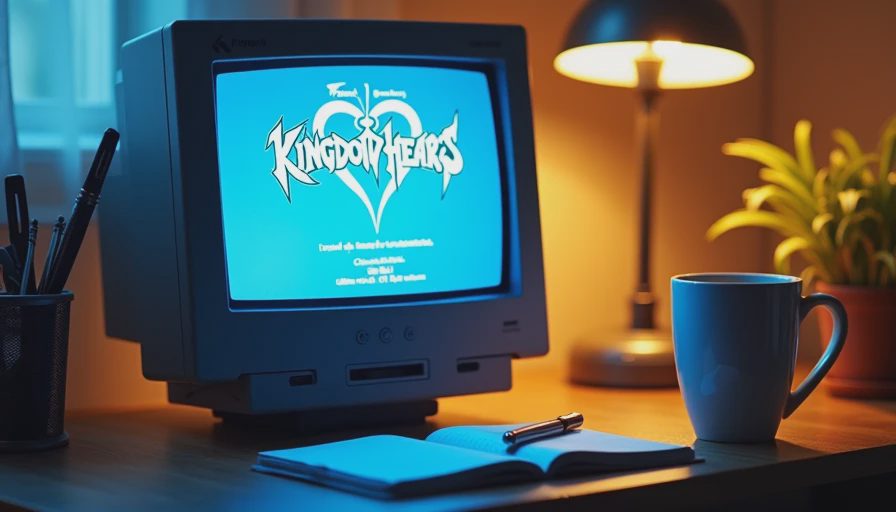
I came back to Kingdom Hearts on a Tuesday night after work, the way I usually do these things—lights low, coffee gone cold on the desk, the insurance paperwork still faintly humming in the back of my head. I hadn’t properly replayed the first game in years. I remembered the feeling more than the details: the way the menu music settled over everything like a warm blanket, the strange comfort of Donald Duck casting Thunder while Sora swung a giant key, the sense that the world was bigger and softer than the one I lived in during the day.
Memory is one thing. Replay is another.
What I found in 2026 is a game that still has a heartbeat, even if some of its joints creak.
What Still Feels Alive
The combat is the first surprise. For a 2002 action RPG, it remains lively and expressive. Combos flow, magic has weight, and the simple pleasure of launching a Heartless into the air and following it with an aerial finisher still lands. It never became the fluid, high-speed spectacle that later entries refined, but it has a clarity and rhythm that a lot of modern action games overcomplicate. You learn the timing, you learn when to guard, and the game rewards you for paying attention without drowning you in systems.
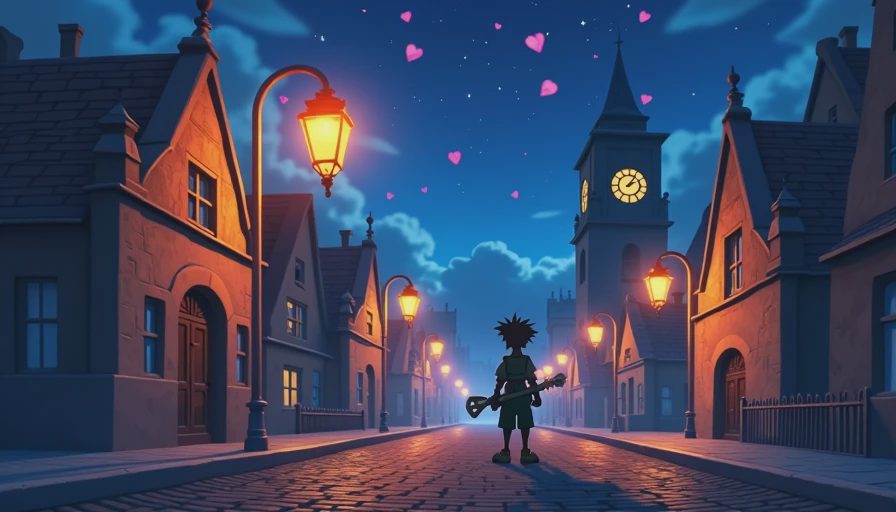
The worlds still work, too. Traverse Town’s quiet streets, the haunted grandeur of Halloween Town, the sun-bleached absurdity of Agrabah—each one feels designed with care rather than obligation. Square Enix and Disney somehow made the crossover feel natural instead of forced. Walking into a Disney world as a teenager with a Keyblade still carries a quiet magic. The presentation has aged into something almost charmingly of its era: the low-poly models, the soft lighting in the HD collections, the way characters move just a little too stiffly. It doesn’t look like a modern game. It looks like a memory that someone carefully cleaned and framed.
And then there’s the music. Yoko Shimomura’s score is still the secret weapon. “Simple and Clean” hits the same way it always did. The battle themes have energy without shouting. The quieter tracks give the game its emotional center. Twenty-four years later, the soundtrack remains one of the strongest reasons to return.
The story, for all its earnestness and occasional cheese, still has sincerity. Sora is a straightforward hero—bright, loyal, a little naïve—and that simplicity works better than I expected as an adult. The game doesn’t try to be clever about friendship or light versus darkness. It just means it. In a media landscape that often treats sincerity as something to be ironized, that directness feels almost radical.
Where the Years Show
The camera remains the biggest practical friction. Even in the HD remasters (the version almost everyone should play now), it sits too close to Sora and can fight you in tight spaces or chaotic fights. You’ll spend moments wrestling the view instead of the enemies. It never ruins the experience, but it is a constant low-level reminder that this game was designed for a different era of control schemes.
Some of the platforming has aged less gracefully. Deep Jungle’s vine-swinging and the swimming sections in Atlantica feel more like chores than adventures. Party member AI can still be unreliable—Donald will sometimes decide the best strategy is to stand in the middle of a group of enemies and cast the wrong spell. None of these issues are deal-breakers, but they accumulate. You notice them more when you’re playing after a long day and your patience is finite.
The middle stretch of the game also sags a little. Once the novelty of visiting new Disney worlds settles, the pacing can feel deliberate in a way that modern games rarely allow. There’s a lot of backtracking, a fair amount of fetch-and-fight, and stretches where the story takes a quiet seat while you simply move from one place to the next. Nostalgia smooths these parts over for people who grew up with the game. For a new player in 2026, they can feel like dead air.
The Gap Between Memory and Replay
As a kid, Kingdom Hearts felt enormous. The worlds stretched on forever. The story felt profound. The Keyblade felt like it carried real weight. Replaying it now, I can see the seams. Some of those worlds are smaller than I remembered. Some of the emotional peaks are simpler than the memory of them. The game is not as deep as the later entries in the series would try to become, and it is not as mechanically refined as Kingdom Hearts II.
But the core feeling survived. That sense of stepping into a slightly stranger, slightly kinder version of childhood still works. The game never stops believing in its own sincerity, and that belief is contagious if you’re willing to meet it halfway.
Who Should Still Play This in 2026
Play it if:
You grew up with the PS2 era and want to revisit something that once felt magical without demanding it still be perfect.
You like action RPGs that prioritize heart and atmosphere over mechanical perfection.
You’re curious about the series and want to start at the beginning with a self-contained story (the first game largely stands on its own).
You’re willing to accept some dated camera work and occasional clunk in exchange for charm, music, and a surprising amount of soul.
You can probably skip it if:
You have very little patience for older control schemes and camera systems.
You need tight modern pacing and quality-of-life features.
You’re mainly interested in the later, more complicated lore and just want the highlights.
Pure mechanical smoothness is non-negotiable for you.
If you do play it, go with the Kingdom Hearts HD 1.5 + 2.5 ReMIX collection. It’s the cleanest, most accessible way to experience the game in 2026, available on current platforms including PC. Play on a difficulty that lets you enjoy the combat rather than fight the systems. Don’t feel obligated to 100% everything on a first (or second) pass.
I finished my replay later than I meant to, the way these sessions often go. The final stretch still has power. The ending still lands with a quiet sincerity that a lot of bigger, louder games never quite manage. I sat there for a minute after the credits, thinking about how rare it is for a game this old to still feel like it has something left to say.
Kingdom Hearts does not hold up perfectly. The camera fights you. Some levels drag. The design shows its age. But the heart of it—the strange, earnest, slightly ridiculous idea that a boy with a Keyblade, a duck, and a dog can travel through Disney worlds and still mean something—still works.
Memory made it larger than it was. Replay showed me what was actually there. And what was actually there is still worth the time, if you’re the kind of player who values warmth over polish.
That’s the verdict from one adult sitting in Ann Arbor after work, still a little surprised that this odd, sincere game still has a pulse.
No feedback yet — submit the first.